

Pakistan’s Climate Crisis: A Youth Plea for Real Governance
As a student at FAST University, Islamabad, I’ve watched as the news about extreme weather shifted from a distant global threat to a terrifying reality right outside our door. We’re not talking about a future crisis anymore; we are living in Pakistan’s climate emergency today. Just look around: it’s the suffocating smog that chokes cities across Punjab every winter, and it’s the devastating floods that submerge entire villages in various areas of Pakistan. The effects of climate change are not just visible—they are inescapable.
But as a young person who will inherit this country, my central question is this: Where is the truly decisive action? Where is the real governance that actually matches the sheer scale and terror of this crisis?
It’s an often-repeated statistic that Pakistan is consistently ranked among the most climate-vulnerable countries, despite contributing less than of global emissions. While that low emission figure makes us feel like victims, the high vulnerability shows a critical flaw in our systems. Our fragile national infrastructure and unprepared institutions are simply failing to cope.
Climate change is not just a problem for the Ministry of Climate Change. It has become a profound economic, social, and security challenge that touches every part of our lives. When floods wipe out cotton crops, it doesn’t just hurt the farmer; it cripples the textile industry, a core pillar of our economy. When heatwaves stress our energy grid, it brings power cuts that stall businesses and make life unbearable for the working class. Our nation’s stability, our economic potential, and our basic human security are all tied to how well we govern our response.
We actually have the basic blueprints. We have the Climate Change Act of 2017, a dedicated Ministry, and ambitious commitments like our Nationally Determined Contributions (NDCs) under the Paris Agreement. The issue isn’t the absence of policy; it’s the failure of governance—the ability to turn those glossy documents into visible, effective action.
Our biggest struggle is the massive gap between what we promise on paper and what we deliver on the ground.
We talk about a shift to renewable energy and massive projects like the Green Pakistan Programme, but the speed of implementation is painfully slow. Think about the move to electric vehicles or the adoption of new, water-saving agricultural techniques—these efforts often stall because the federal and provincial governments struggle to work together.
Following the 18th Amendment, provinces have taken on significant environmental powers, which is a good thing for local ownership. However, without the necessary technical training, funding, and clear central guidance, these provincial departments often lack the capacity to execute complex, long-term climate-resilient development plans. The result is a broken chain of command where responsibility is passed around but action is diluted.
For climate action to be real, it must be well-funded and managed by rock-solid institutions. Adaptation—building resilience to the changes that are already here—requires huge, sustained investment in infrastructure, water management, and early warning systems.
We can’t just wait for international aid. While foreign climate finance is critical, we need to be creative and strategic domestically. This means actively exploring mechanisms like green bonds, setting up public-private partnerships, and dedicating a national equity fund, perhaps even a small percentage of our GDP, solely to climate resilience projects.
Furthermore, the money we do secure must be managed with absolute transparency and accountability. Any fund must be traceable, ensuring it reaches the most vulnerable communities and isn’t lost in bureaucratic limbo or funneled into projects that don’t genuinely enhance climate resilience. The frequent institutional changes—like the debate around the Climate Change Authority (CCA) and the constant leadership reshuffles—only ensure that no long-term vision takes root. We desperately need stable, independent, and technically sound institutions that are protected from the usual political chaos.
As students, we are the ones who will bear the consequences of poor governance. While we are often told we are the future, we are also the present, and we understand the severity of this crisis better than most.
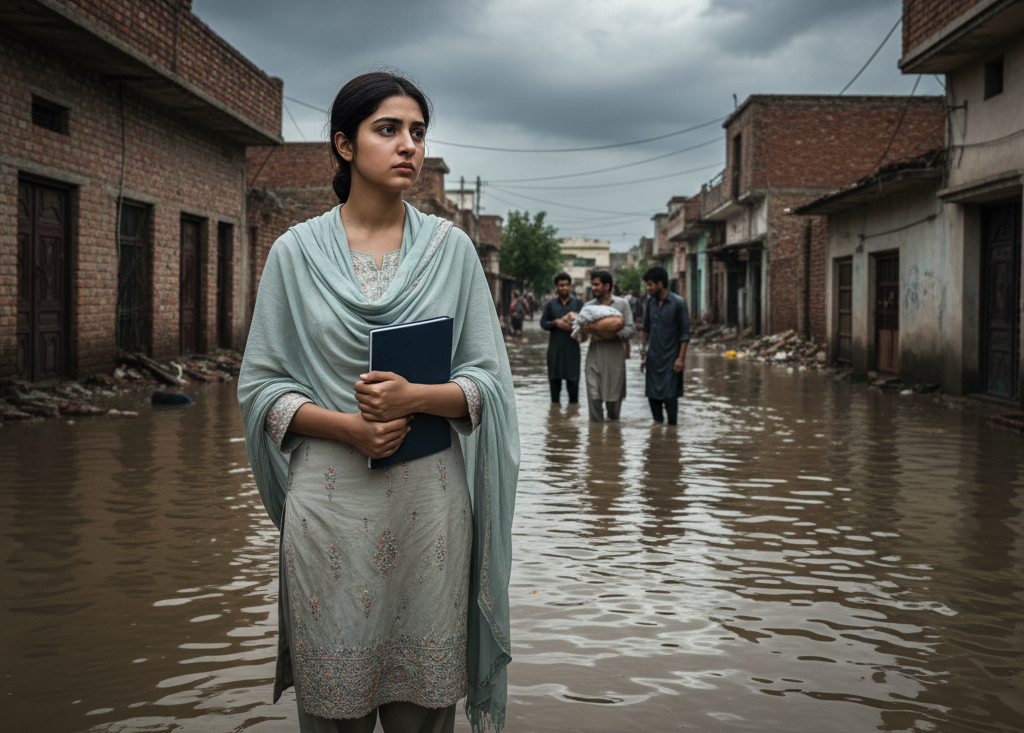
We need to demand a new level of governance. This should include:
- Public Transparency: We need a simple, accessible National ‘Climate Dashboard’ that clearly tracks the progress and expenditure of all major climate projects. We need verifiable data, not just vague statistics or impressive-sounding claims.
- Integrated Planning: Every major national plan—from infrastructure development to poverty reduction—must include a mandatory ‘Climate Impact Assessment.’ We can no longer afford to build a road or a dam that will simply be washed away by the next mega-flood or that will worsen our carbon footprint.
- Empowering the Local Level: Give local governments the resources they need. Climate solutions are most effective when they are designed and implemented by those closest to the problems on the ground.
To the policymakers reading this: the time for symbolic gestures is over. Pakistan’s climate governance must move from being reactive—scrambling after a disaster—to being proactive, strategically integrated, and, most importantly, accountable to the people.
To my fellow youth: we cannot afford to be passive. We must use our collective voice—in our universities, in civil society, and online—to hold our government and ourselves accountable. Climate governance is not a separate, niche policy area; it is the shared responsibility of every Pakistani. We must push for a governing system that secures a truly resilient and sustainable future for our nation. Our survival depends on it.

Ramisha Shafqat
About Author :Ramisha Shafqat is a passionate environmental advocate and student at FAST University, Islamabad. Deeply concerned about Pakistan’s growing climate challenges, she uses her voice to highlight the urgent need for effective governance, sustainable development, and youth participation in climate action. Ramisha believes that awareness must turn into accountability—and that the young generation holds the power to push Pakistan toward a greener, more resilient future.
